中国神经再生研究(英文版) ›› 2026, Vol. 21 ›› Issue (10): 4924-4932.doi: 10.4103/NRR.NRR-D-25-00123

• 原著:脑损伤修复保护与再生 • 上一篇    下一篇

脑卒中后康复:个体化疲劳水平控制跑步机训练


  • 出版日期:2026-10-15 发布日期:2026-06-13
  • 基金资助:
    该研究得到了GRF 15207120, 15218324, ITT/012/23GP, PolyU 1-ZVVP and 1-CD74,浙江省康复医学会科研项目(ZKKY2024008)支持

Post-stroke rehabilitative mechanisms in individualized fatigue level–controlled treadmill training in rats 

Yuchen Xu1, 2, Yulong Peng2, Yuanfa Yao3, Xiaoman Fan2, Minmin Wang2, 4, Feng Gao5, Mohamad Sawan1, *, Shaomin Zhang2, *, Xiaoling Hu6   

  1. 1CenBRAIN Neurotech Center of Excellence, School of Engineering, Westlake University, Hangzhou, Zhejiang Province, China; 
    2Key Laboratory of Biomedical Engineering of Ministry of Education, Qiushi Academy for Advanced Studies, Zhejiang University, Hangzhou, Zhejiang Province, China; 
    3The Affiliated Huizhou Hospital, Guangzhou Medical University, Guangzhou, Guangdong Province, China; 
    4Westlake Institute for Optoelectronics, Westlake University, Hangzhou, Zhejiang Province, China; 
    5Department of Neurology, The Second Affiliated Hospital, School of Medicine, Zhejiang University, Hangzhou, Zhejiang Province, China; 
    6Department of Biomedical Engineering, The Hong Kong Polytechnic University, Kowloon, Hong Kong Special Administrative Region, China
  • Online:2026-10-15 Published:2026-06-13
  • Contact: Mohamad Sawan, PhD, sawan@westlake.edu.cn; Shaomin Zhang, PhD, shaomin@zju.edu.cn.
  • Supported by:
    This study was supported by General Research Fund, Nos. GRF15207120, 15218324 (both to XH); Innovation and Technology Fund ITT/012/23GP, PolyU 1-ZVVP and 1-CD74 (to XH); Research Special Fund Project of Zhejiang Association of Rehabilitation Medicine, No. ZKKY2024008 (to MW).

摘要:

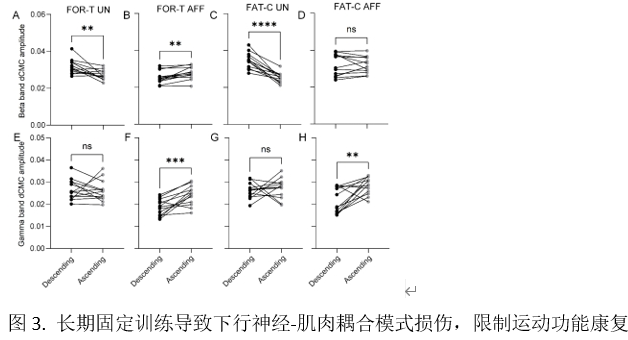
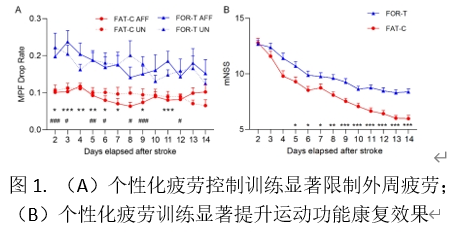
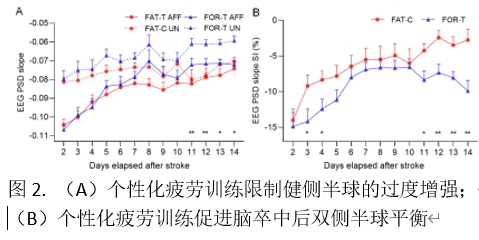
临床个性化训练可提升脑卒中后运动功能康复效率;然而,关于个性化训练促进康复的机制仍存在不明确之处。实验通过脑卒中大鼠模型,探讨个性化训练过程中皮质及皮质肌肉康复效应在大鼠后运动功能恢复中的作用。通过在层后第2-14天期间实施强制训练(FOR-T)或个性化疲劳控制训练。结果显示,个性化疲劳控制训练组的运动功能恢复效果优于强制训练组,且中枢疲劳程度更低。脑电图功率谱密度斜率分析显示,个性化疲劳控制训练组的半球间平衡优于强制训练组。定向皮层肌肉一致性分析表明,训练诱导的疲劳导致下行定向皮层肌肉一致性的短期下调和上行定向皮层肌肉一致性的上调。长期来看,过度疲劳阻碍了受累半球下降控制的恢复。基于外周疲劳控制的个性化训练策略实现了更好的运动功能恢复,这可归因于中枢疲劳的缓解、半球间平衡的优化以及受累半球下降控制的增强。这是首个在皮层和皮层肌肉水平上探讨个性化康复效果机制的研究,这些发现表明,根据疲劳水平量身定制的个性化训练方案可显著提升卒中后运动效率,并为临床实践中开发疲劳监测的个性化康复项目提供了机制基础。


https://orcid.org/0000-0002-4137-7272 (Mohamad Sawan); https://orcid.org/0000-0001-6311-5946 (Shaomin Zhang)
关键词: 脑卒中, 卒中康复, 运动功能, 疲劳, 半球间平衡, 定向皮层肌肉一致性, 个体化训练, 中枢疲劳, 外周疲劳, 神经再生

Abstract: Clinically, individualized training improves post-stroke motor function rehabilitation efficiency. However, the mechanisms underlying how individualized training facilitates recovery remain relatively unclear. Here, we explored the cortical and corticomuscular rehabilitative effects of post-stroke motor function recovery during individualized training using a rat model of intracerebral hemorrhage. Forced training or individualized fatigue-controlled training was provided from days 2 to 14 post-stroke. The fatigue-controlled training group exhibited superior motor function recovery and less central fatigue compared with the forced training group. Electroencephalograph power spectrum density slope analysis demonstrated better inter-hemispheric balance in the fatigue-controlled training group than in the forced training group. Directed corticomuscular coherence analysis indicated that training-induced fatigue led to a short-term downregulation of descending directed corticomuscular coherence and an upregulation of ascending directed corticomuscular coherence. In the long term, excessive fatigue hindered the recovery of descending control in the affected hemisphere. In conclusion, the individualized strategy of peripheral fatigue-controlled training achieved better motor function recovery, which may be attributed to the mitigation of central fatigue, optimization of inter-hemispheric balance, and enhancement of descending control in the affected hemisphere. This is the first study to investigate the mechanisms underlying individualized rehabilitative effects at the cortical and corticomuscular levels. Our findings suggest that personalized training protocols that are tailored to manage fatigue levels may substantially enhance post-stroke motor efficiency. They also provide a mechanistic foundation for developing fatigue-monitored, individualized rehabilitation programs in clinical practice.

Key words: central fatigue, corticomuscular coherence, electroencephalography, fatigue, individualized training, interhemispheric balance, motor function recovery, peripheral fatigue, stroke rehabilitation, treadmill training