中国神经再生研究(英文版) ›› 2026, Vol. 21 ›› Issue (10): 4989-4999.doi: 10.4103/NRR.NRR-D-25-00404

• 原著:退行性病与再生 • 上一篇    下一篇

工程化间充质干细胞来源细胞外囊泡过表达miR-146a缓解阿尔茨海默病神经炎症


  • 出版日期:2026-10-15 发布日期:2026-06-15

Engineered mesenchymal stem cell–derived extracellular vesicles overexpressing miR-146a alleviate neuroinflammation in Alzheimer’s disease

Jia Zhang1, 2, #, Siqi He1, 2, #, Qiguo Xiao1, #, Weijie Jiang1, Bo Wang3, 4, Jing Lu1, Hongfeng Gu3, Yajin Liao1, Zhi Wang1, Ying Xu5, Dan Wang6, *, Xiaoqing Tang1, 3, *, Ling Qi2, *   

  1. 1The Second Affiliated Hospital, University of South China, Hengyang, Hunan Province, China; 
    2Division of Gastroenterology, Institute of Digestive Disease, the Affiliated Qingyuan Hospital of Guangzhou Medical University, Qingyuan People’s Hospital, Qingyuan, Guangdong Province, China; 
    3Department of Physiology & Key Laboratory of Hunan Province for Major Brain Diseases, Hengyang Medical School, University of South China, Hengyang, Hunan Province, China; 
    4The First Affiliated Hospital, Institute of Anesthesiology, University of South China, Hengyang, Hunan Province, China; 
    5Guangdong-Hong Kong-Macau Institute of Central Nervous System Regeneration, Key Laboratory of Central Nervous System Regeneration, Ministry of Education, Jinan University, Guangzhou, Guangdong Province, China; 
    6Department of pathology, Beihua University, Jilin, Jilin Province, China

  • Online:2026-10-15 Published:2026-06-15
  • Contact: Dan Wang, PhD, jljl1215@163.com; Xiaoqing Tang, PhD, tangxq-usc@usc.edu.cn; Ling Qi, PhD, qiling1718@gzhmu.edu.cn.
  • Supported by:
    This work was supported by the Natural Science Foundation of Hunan Province, Nos. 2025JJ81006 (to JZ), 2025JJ90150 (to QX), 2022JJ30522 (to QX), 2022JJ70034 (to ZW); Clinical Medical Technology Innovation Guidance Project of Hunan Province, No. 2021SK51813 (to BW).

摘要:

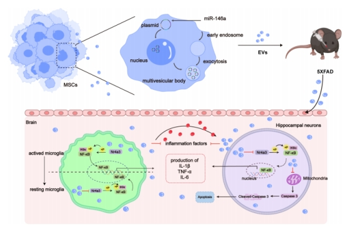
阿尔茨海默病是一种炎症性神经退行性疾病,目前临床尚无有效治疗方法。以往研究显示,间充质干细胞来源的细胞外囊泡通过miR-146a–Nr4a3轴发挥抗炎作用,延缓视网膜退化,但Nr4a3如何驱动炎症的机制尚不明确。在此,实验通过工程化构建了过表达miR-146a的间充质干细胞来源的细胞外囊泡,以探索其在阿尔茨海默病细胞和动物模型中的潜在神经保护作用及机制。间充质干细胞来源的细胞外囊泡显著减少了凋亡细胞的数量,并抑制了与脂多糖诱导的RAW264.7/BV2细胞共培养的HT22细胞中促炎性细胞因子的表达、核因子κB的激活以及caspase3/Bax信号通路的激活。这些间充质干细胞来源的细胞外囊泡的作用在5×FAD小鼠中得到了验证。此外,间充质干细胞来源的细胞外囊泡抑制了小胶质细胞和星形胶质细胞的活化,降低了淀粉样β蛋白和磷酸化tau蛋白的表达,减少了海马区凋亡细胞数量,并改善了阿尔茨海默病小鼠的认知功能。机制上,miR-146a通过负调控Nr4a3的表达,抑制了促炎性细胞因子的表达和核因子κB信号通路。此外,过表达Nr4a3促进了核因子κB、促炎性细胞因子和核因子κB信号通路的表达。Nr4a3的上调和炎症反应通过miR-146a过表达得到逆转。最后,通过ChIP-PCR鉴定Nr4a3为核因子κB的转录激活因子。因此,间充质干细胞来源的细胞外囊泡通过Nr4a3–核因子B轴发挥抗炎作用和缓解阿尔茨海默病的进展,使其成为临床治疗神经退行性疾病的潜在治疗候选物。


https://orcid.org/0000-0001-7756-7104 (Dan Wang); 

https://orcid.org/0000-0002-3518-9275 (Xiaoqing Tang); 

https://orcid.org/0000-0002-6275-3599 (Ling Qi)

关键词: 阿尔茨海默病, 间充质干细胞来源的细胞外囊泡, miR-146a过表达, Nr4a3, 核因子κB, 组织工程, 小胶质细胞, 神经炎症, 神经再生

Abstract: Alzheimer’s disease is an inflammatory neurodegenerative disease for which no effective clinical treatment currently exists. We have previously reported that mesenchymal stem cell–derived extracellular vesicles delay retinal degeneration by exerting anti-inflammatory effects though the miR-146a–nuclear receptor subfamily 4 group A member 3 axis; however, it remains unclear how NR4A3 drives inflammation. Herein, we engineered mesenchymal stem cell–derived extracellular vesicles overexpressing miR-146a to explore their possible neuroprotective effects and the underlying mechanisms in both cell and animal models of Alzheimer’s disease. In HT22 cells co-cultured with lipopolysaccharide-induced RAW264.7/BV2 cells, extracellular vesicles overexpressing miR-146a significantly reduced the number of apoptotic cells and inhibited proinflammatory cytokine expression, nuclear factor (NF)-κB activation, and caspase-3/apoptosis regulator BAX signaling. These effects of extracellular vesicles overexpressing miR-146a were replicated in 5×FAD mice. In addition, extracellular vesicles overexpressing miR-146a inhibited the activation of microglia and astrocytes, reduced amyloid-β and phosphorylated tau expression, lowered the number of apoptotic cells in the hippocampus, and improved the cognitive function of these Alzheimer’s disease model mice. Mechanistically, miR-146a negatively regulated the expression of nuclear receptor subfamily 4 group A member 3 and suppressed the expression of proinflammatory cytokines and nuclear factor-κB signaling. Furthermore, NR4A3 overexpression promoted nuclear factor-κB and proinflammatory cytokine expression as well as nuclear factor-κB signaling. The upregulation of NR4A3 and the inflammatory response was reversed by miR-146a overexpression. Finally, NR4A3 was identified as a transcriptional activator of nuclear factor-κB using chromatin immunoprecipitation polymerase chain reaction. Collectively, these findings indicate that extracellular vesicles overexpressing miR-146a may alleviate the progression of Alzheimer’s disease by exerting anti-inflammatory effects via the NR4A3–nuclear factor-κB axis. They are thus a potential therapeutic candidate for the clinical treatment of neurodegenerative diseases.

Key words: Alzheimer’s disease, amyloid-β, cognitive function, mesenchymal stem cell–derived extracellular vesicles, microglia, miR-146a, neuroinflammation, neuroprotection, nuclear factor-κB, nuclear receptor subfamily 4 group A member 3 (NR4A3)