中国神经再生研究(英文版) ›› 2026, Vol. 21 ›› Issue (7): 3202-3208.doi: 10.4103/NRR.NRR-D-24-01473

• 原著:视神经损伤修复保护与再生 • 上一篇    下一篇

枸杞糖肽和木犀草素互作干预N-甲基-N-亚硝基脲诱导的小鼠光感受器变性


  • 出版日期:2026-07-15 发布日期:2026-03-31

Lycium barbarum glycopeptide and luteolin synergistically protect mouse photoreceptors against N-nitroso-N-methylurea-induced degeneration

Xiu Han1, #, Qihang Kong2, 3, #, Yajing Liu1, Xuesong Mi3, 4, Shibo Tang2, 4, *, Kwok-Fai So1, 4, 5, 6, *, Ying Xu1, 4, 6, *   

  1. 1Guangdong-Hongkong-Macau Institute of CNS Regeneration, Key Laboratory of CNS Regeneration (Jinan University)-Ministry of Education, Guangdong Key Laboratory of Nonhuman Primate Research, Jinan University, Guangzhou, Guangdong Province, China; 
    2Aier Eye Hospital, Jinan University, Guangzhou, Guangdong Province, China; 
    3Department of Ophthalmology, The First Affiliated Hospital of Jinan University, Guangzhou, Guangdong Province, China; 
    4Aier Academician Station, Changsha, Hunan Province, China; 5State Key Laboratory of Brain and Cognitive Sciences, Hong Kong Special Administrative Region, China; 6Co-Innovation Center of Neuroregeneration, Nantong University, Nantong, Jiangsu Province, China
  • Online:2026-07-15 Published:2026-03-31
  • Supported by:
    This work was supported by the Natural Science Foundation of Guangdong Province, No. 2023A1515012397 (to YX); the National Natural Science Foundation of China, No. 82074169 (to XM); the Guangdong Basic and Applied Basic Research Foundation, No. 2021A1515012473 (to XM); and Project of Administration of Traditional Chinese Medicine of Guangdong Province, No. 20202045 (to XM); Aier Eye Hospital Group, No. AF2019001 (to ST, KFS, YX, and XM).

摘要:

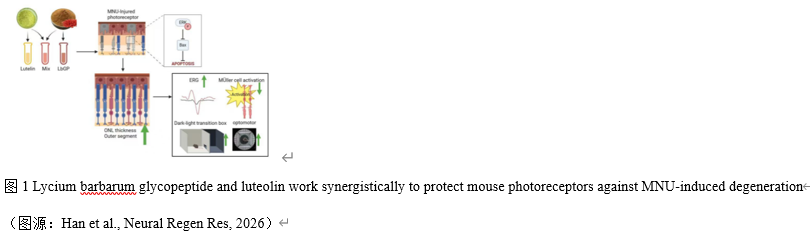
光感受器变性是遗传性视网膜色素变性等疾病中导致视力损害的核心病理过程,目前尚无有效治疗手段。此前研究表明,枸杞糖肽和木犀草素单独使用可部分改善小鼠光感受器存活和功能,但效果有限。实验旨在评估枸杞糖肽和木犀草素联合使用是否能比单独使用对退变的光感受器产生更好的治疗效果。选取野生型小鼠C57BL/6J作为实验对象,枸杞糖肽和木犀草素每日灌胃,持续7d后,通过腹腔注射N-甲基-N-亚硝基脲(MNU)诱导光感受器损伤,以模拟临床中光感受器变性的病理过程。在光感受器损伤发生后,小鼠继续接受枸杞糖肽和木犀草素治疗1周。治疗结束后,应用视网膜电图、视觉行为检测及免疫荧光染色等多种技术对小鼠视网膜的结构和功能进行全面评估。结果显示,枸杞糖肽和木犀草素联合用药显著提高了感光细胞的存活率,改善了视网膜光反应和小鼠视觉行为。从机制层面来看,联合用药通过抑制视网膜炎症并调节ERK- Bax/Bcl-2 通路发挥抗炎和抗凋亡保护作用。与单独用药相比,联合用药显著增加了感光细胞层厚度,延长了视锥视杆细胞外段层长度,在减轻视网膜炎症、保护光感受器方面效果更优。结果表明,枸杞糖肽与木犀草素联合用药有望成为一种具有前景的治疗光感受器变性的策略。


https://orcid.org/0000-0003-2737-6780 (Shibo Tang); 

https://orcid.org/0000-0003-4039-4246 (Kwok-Fai So); 

https://orcid.org/0000-0002-9987-2057 (Ying Xu)

关键词: 炎症, 遗传性视网膜疾病, 木犀草素, 枸杞糖肽, N-亚硝基-N-甲基脲, 光感受器, 反应性胶质细胞病变, 视网膜变性, 视网膜色素变性, 枸杞提取物

Abstract:

Photoreceptor degeneration is a major cause of vision impairment in retinal diseases, for which no effective treatment currently exists. Previous research by our team demonstrated that Lycium barbarum glycopeptide and luteolin can independently promote photoreceptor survival and function in degenerated mouse retinas, although with limited efficacy. This study evaluated whether a combination of Lycium barbarum glycopeptide and luteolin provides enhanced therapeutic benefits compared with either compound alone. Wild-type mice received a daily oral gavage of Lycium barbarum glycopeptide and luteolin for 7 days prior to intraperitoneal injection of N-nitroso-N-methylurea to induce photoreceptor damage. The treatment continued for an additional week after injury. Retinal structure and function were subsequently assessed using electroretinogram recordings, visual behavior testing, and immunostaining. Western blot analysis was conducted to investigate the underlying protective mechanisms. The results showed that the Lycium barbarum glycopeptide-luteolin mixture significantly increased photoreceptor survival, improved retinal light response, and enhanced visual behavior. Importantly, the combination outperformed either compound alone in protective efficacy. Mechanistic analysis indicated that the mixture suppressed retinal inflammation and modulated the extracellular signal-regulated kinase and Bcl-2-associated X protein/B-cell lymphoma 2 signaling pathways. These findings suggest that the combination of Lycium barbarum glycopeptide and luteolin represents a promising therapeutic strategy for photoreceptor degeneration.

Key words: inflammation, inherited retinal diseases, luteolin, Lycium barbarum glycopeptide, N-nitroso-N-methylurea, photoreceptor, reactive gliosis, retinal degeneration, retinitis pigmentosa, wolfberry extract