NRR:中国南昌大学附属康复医院冯珍教授团队揭示低强度聚焦超声可减轻创伤性脑损伤后血管功能障碍的机制
撰文:任炳开,冯珍
创伤性脑损伤(Traumatic brain
injury)是导致神经功能障碍和死亡的主要原因 [1]。据报道,创伤性脑损伤的全球发病率每年超过5000万例,中国每年新增创伤性脑损伤患者300余万例,并呈逐年上升趋势,给家庭和社会带来了沉重的精神压力和经济负担 [2, 3]。如何有效地加快创伤性脑损伤患者的恢复进程、减少致残率和死亡率以及提高其生存质量,已成为医学领域亟待解决的难题。低强度聚焦超声(Low intensity
focused ultrasound)是超声波的一种形式,其主要依靠空化效应和机械效应发挥作用,具有无创、短暂、耐受良好的的特点,可调控大脑的任何的目标区域。低强度聚焦超声对神经组织的神经刺激作用早已在体外组织培养、非人类动物模型和最近的人类身上得到证明 [4, 5]。但低强度聚焦超声治疗创伤性脑损伤的作用机制尚不明确。
中国南昌大学附属康复医院冯珍教授团队在《中国神经再生研究(英文)》(Neural Regeneration
Research)上发表了题为“Mechanism by
which low-intensity focused ultrasound promotes angiogenesis and neurogenesis
after traumatic brain injury in a rat model via the OXA/MAPK signaling pathway”的研究发现,低强度聚焦超声可有效地缓解创伤性脑损伤大鼠的脑水肿,减轻血脑屏障损伤,从而改善神经功能。其治疗机制是通过促进Orexin-A分泌以增强血管新生和神经再生,且Orexin-A还能能够激活MAPK信号通路。进一步通过体外实验证实,Orexin-A可通过调控MAPK信号通路促进内皮细胞血管形成和海马神经元生长。因此,研究提示,低强度聚焦超声能促进血管新生和神经再生,其可能在未来治疗创伤性脑损伤患者的应用中提供临床前证据。任炳开,康君伟,姚鹏为并列同第一作者,白洋教授和冯珍教授为并列通讯作者。
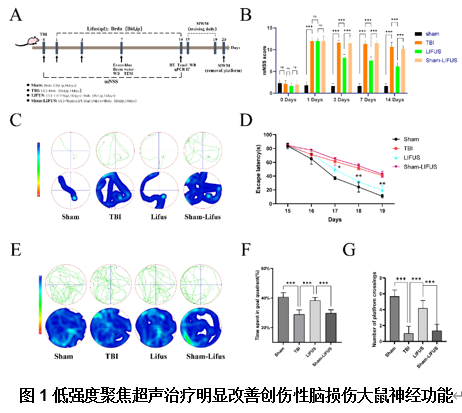
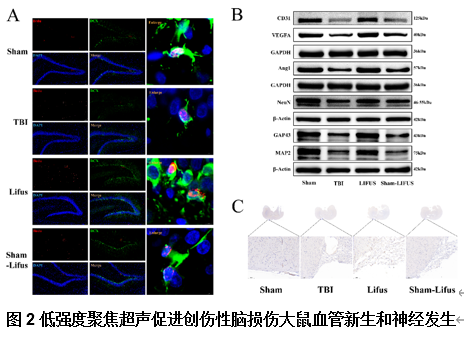
创伤性脑损伤通常会导致脑血管功能障碍 [6],而脑血管网络对于维持脑组织的代谢和功能至关重要。促进血管新生可以为神经新生提供所必需的氧气和营养物质,这对创伤性脑损伤后大脑的功能修复至关重要 [7]。神经新生在补充丢失的神经元和重建受损大脑内的神经调节网络方面至关重要,有助于创伤性脑损伤后的神经恢复 [8, 9]。因此,冯珍等首先观察了低强度聚焦超声治疗是否能促进血管新生和神经再生,改善创伤性脑损伤大鼠神经功能的作用。行为学实验证实低强度聚焦超声可明显改善创伤性脑损伤大鼠神经功能(图1),免疫组化和和免疫荧光结果显示,低强度聚焦超声可明显促进血管新生和神经发生(图2)。
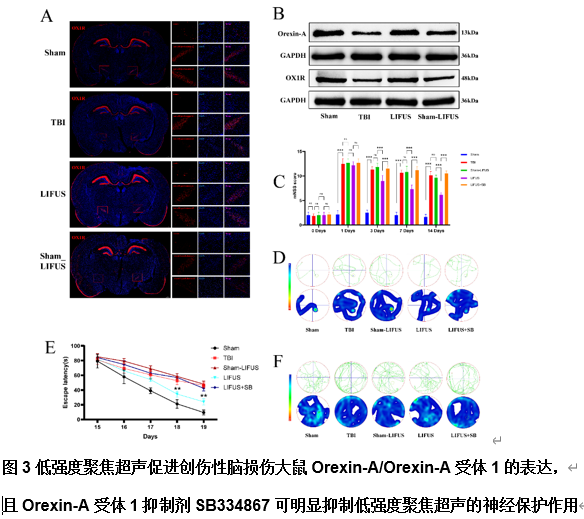
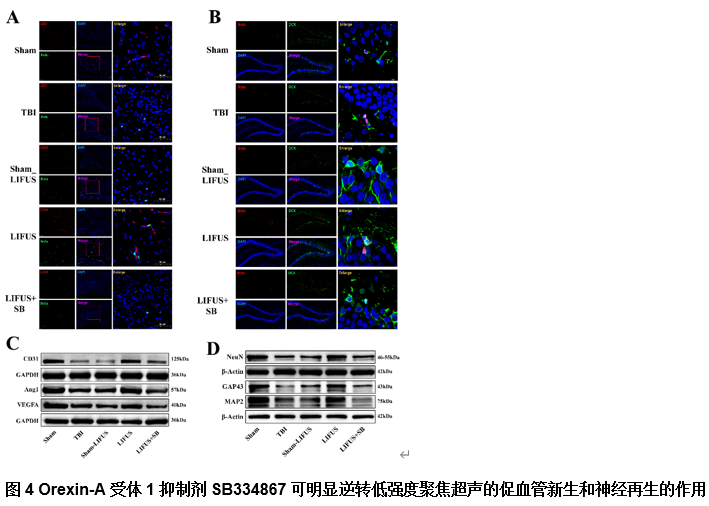
冯珍等前期研究已表明,低强度聚焦超声可促进下丘脑Orexin-A释放,发挥神经保护作用,从而改善意识水平为明确低强度聚焦超声治疗创伤性脑损伤大鼠 [10]。Orexin-A现在被认为是由下丘脑外侧区合成和分泌的,投射到前额叶皮质。Orexin-A通过减轻神经元退化和防止细胞死亡显示出神经保护作用 [11, 12]。有研究学者基于细胞实验,揭示了Orexin-A作为一种新型促血管生成肽的功能 [13]。然而,Orexin-A在低强度聚焦超声促进创伤性脑损伤后血管生成和改善神经功能方面的作用仍未得到充分研究。因此,实验通蛋白印迹和免疫荧光检测脑组织中Orexin-A和Orexin-A受体1的表达水平,发现低强度聚焦超声治疗后,Orexin-A/Orexin-A受体1表达明显升高,且使用Orexin-A受体1抑制剂SB334867后,低强度聚焦超声神经功能保护作用明显收到抑制(图3),血管新生和神经再生明显减少(图4)。
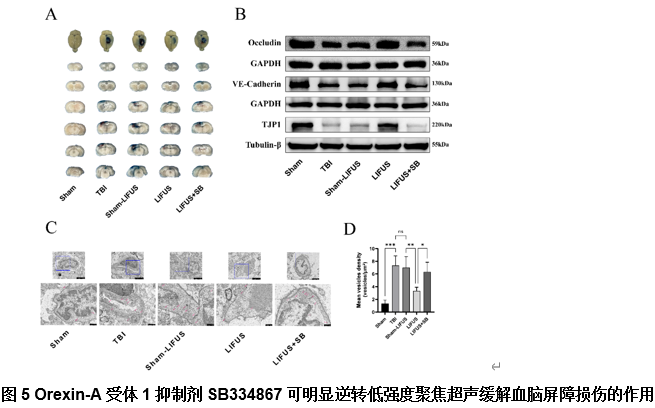
血脑屏障功能障碍是创伤性脑损伤后常见的病理生理特征 [14]。创伤性脑损伤可导致紧密连接复合物破坏,细胞间隙扩大,脉管系统收缩以及血管腔缩小,并出现细胞肿胀。持续性血脑屏障破坏可以诱导慢性神经炎性反应及癫痫发作 [15, 16]。研究发现低强度聚焦超声可明显改善创伤性脑损伤大鼠血脑屏障损伤,且与Orexin-A/Orexin-A受体1密切相关(图5)。
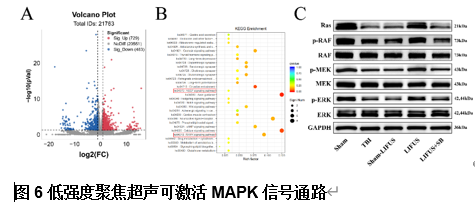
为进一步探究低强度聚焦超声治疗创伤性脑损伤大鼠的潜在机制,作者通过转录组测序寻找低强度聚焦超声治疗后脑组织中的差异表达基因,并通过KEGG通路富集和蛋白印迹验证。结果显示低强度聚焦超声可以激活MAPK信号通路(图6)。
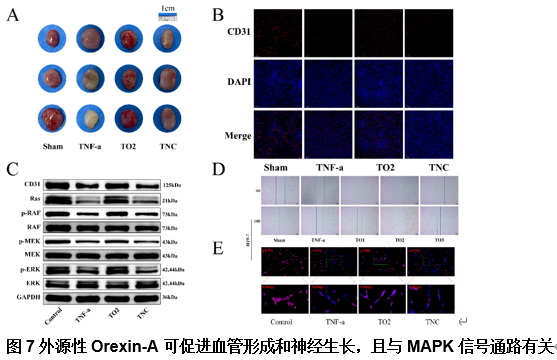
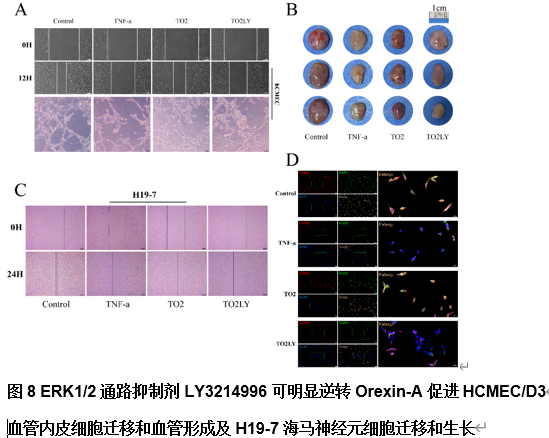
最后,为进一步明确Orexin-A促进促进血管新生和神经再生是否是通过调控MAPK信号通路,冯珍等通过肿瘤坏死因子α构建体外细胞损伤模型,通过免疫荧光和蛋白印迹检测血管内皮细胞基质胶栓和海马神经细胞H19-7中P-ERK的表达水平,结果显示Orexin-A可明显激活MAPK信号通路,促进血管和神经生长(图7)。然后再使用ERK1/2抑制剂LY3214996进行回复实验。结果发现 LY3214996可明显抑制Orexin-A对HCMEC/D3血管内皮细胞迁移和血管形成的作用,且同样抑制Orexin-A对H19-7海马神经元细胞迁移和生长的作用(图8)。
总之,此项研究证实低强度聚焦超声可通过调控Orexin-A/Orexin-A受体1的表达,进而激活MAPK信号通路,发挥促进血管新生和和神经再生改善创伤性脑损伤大鼠神经功能的作用。此项研究结果将为低强度聚焦超声治疗创伤性脑损伤患者提供了临床前证据。
但是此次实验只关注雄性大鼠和治疗14d的这一时间点。为有更多的临床意义,未来的研究应该考虑使用雌性大鼠,以及更长时间的低强度聚焦超声治疗(比如21或28d)。此外,研究中低强度聚焦超声治疗是在创伤性脑损伤急性期进行干预治疗的,后期可尝试探究不同时机下进行低强度聚焦超声治疗创伤性脑损伤的效果,探寻最佳治疗时机。
#br#
原文链接:https://doi.org/10.4103/NRR.NRR-D-24-01153
参考文献#br#
[1]
Maiese A, Spina F, Visi G, et al. The expression of FOXO3a as a forensic diagnostic tool in cases of traumatic brain injury: an immunohistochemical study. Int J Mol Sci. 2023;24(3):2584.#br#
[2]
Ding C, Wu Y, Chen X, et al. Global, regional, and national burden and attributable risk factors of neurological disorders: The Global Burden of Disease study 1990-2019. Front Public Health. 2022;10:952161.#br#
[3]
Dewan MC, Rattani A, Gupta S, et al. Estimating the global incidence of traumatic brain injury. J Neurosurg. 2019;130(4):1080-1097.#br#
[4]
Bystritsky A, Korb AS. A review of low-intensity transcranial focused ultrasound for clinical applications. Curr Behav Neurosci Rep. 2015;2(2):60-66.#br#
[5]
Su WS, Wu CH, Chen SF, et al. Low-intensity pulsed ultrasound improves behavioral and histological outcomes after experimental traumatic brain injury. Sci Rep. 2017;7(1):15524.#br#
[6]
Jullienne A, Obenaus A, Ichkova A, et al. Chronic cerebrovascular dysfunction after traumatic brain injury. J Neurosci Res. 2016;94(7):609-622.#br#
[7]
Zhang J, Liu X, Ma K, et al. Collagen/heparin scaffold combined with vascular endothelial growth factor promotes the repair of neurological function in rats with traumatic brain injury. Biomater Sci. 2021;9(3):745-764.#br#
[8]
He J, Huang Y, Liu H, et al. Bexarotene promotes microglia/macrophages - Specific brain - Derived Neurotrophic factor expression and axon sprouting after traumatic brain injury. Exp Neurol. 2020;334:113462.#br#
[9]
Redell JB, Maynard ME, Underwood EL, et al. Traumatic brain injury and hippocampal neurogenesis: Functional implications. Exp Neurol. 2020;331:113372.#br#
[10]
Huang L, Kang J, Chen G, et al. Low-intensity focused ultrasound attenuates early traumatic brain injury by OX-A/NF-κB/NLRP3 signaling pathway. Aging (Albany NY). 2022;14(18):7455-7469.#br#
[11]
Adamantidis AR, Zhang F, Aravanis AM, et al. Neural substrates of awakening probed with optogenetic control of hypocretin neurons. Nature. 2007;450(7168):420-424.#br#
[12]
Shirasaka T, Yonaha T, Onizuka S, et al. Effects of orexin-A on propofol anesthesia in rats. J Anesth. 2011;25(1):65-71.#br#
[13]
Kim MK, Park HJ, Kim SR, et al. Angiogenic role of orexin-A via the activation of extracellular signal-regulated kinase in endothelial cells. Biochem Biophys Res Commun. 2010;403(1):59-65.#br#
[14]
Hay JR, Johnson VE, Young AM, et al. Blood-brain barrier disruption is an early event that may persist for many years after traumatic brain injury in humans. J Neuropathol Exp Neurol. 2015;74(12):1147-1157.#br#
[15]
Tang Y, Dong X, Chen G, et al. Vagus nerve stimulation attenuates early traumatic brain injury by regulating the NF-κB/NLRP3 signaling pathway. Neurorehabil Neural Repair. 2020;34(9):831-843.#br#
[16]
Glushakova OY, Johnson D, Hayes RL. Delayed increases in microvascular pathology after experimental traumatic brain injury are associated with prolonged inflammation, blood-brain barrier disruption, and progressive white matter damage. J Neurotrauma. 2014;31(13):1180-1193.#br#
