中国神经再生研究(英文版) ›› 2026, Vol. 21 ›› Issue (8): 3659-3667.doi: 10.4103/NRR.NRR-D-24-00714

• 原著:脑损伤修复保护与再生 • 上一篇    下一篇

5-O-甲基维斯阿米醇苷减轻脂多糖诱导抑郁样行为的作用机制


  • 出版日期:2026-08-18 发布日期:2026-04-27

5-O-Methylvisammioside alleviates depression-like behaviors by inhibiting nuclear factor kappa B pathway activation via targeting SRC

Wenqian Zhu, Bingjin Li*, Ranji Cui*   

  1. Jilin Provincial Key Laboratory of Molecular and Chemical Genetic, Second Hospital of Jilin University, Changchun, Jilin Province, China
  • Online:2026-08-18 Published:2026-04-27
  • Contact: Ranji Cui, PhD, cuiranji@jlu.edu.cn; Bingjin Li, PhD, libingjin@jlu.edu.cn.
  • Supported by:
    The study was supported by a grant from Department of Science and Technology of Jilin Province, No. 20230204039YY (to RC); and the Construction Project for Antidepressant Screening Engineering Laboratory of Jilin Province, No. 2023C010 (to BL).

摘要:

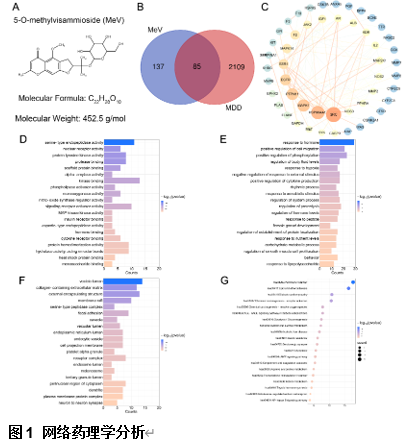
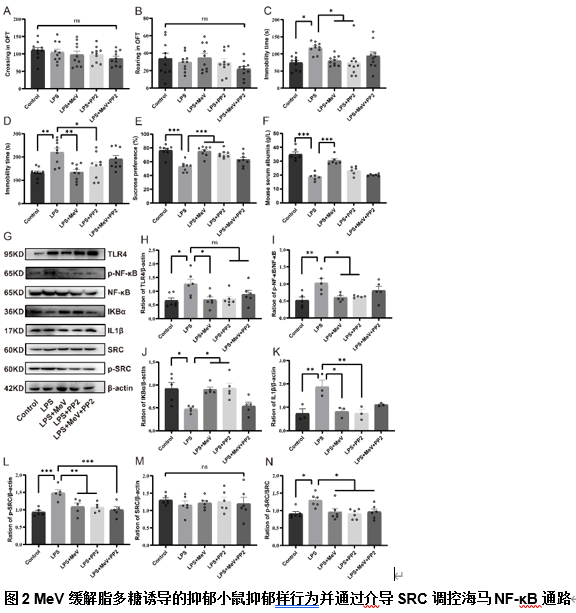
5-O-甲基维斯阿米醇苷(MeV)是从防风干根提取的一种生物活性化合物。此次实验研究旨在通过网络药理学分析结合生物学实验,探索5-O-甲基维斯阿米醇苷治疗重度抑郁机制中涉及的靶点和信号通路。网络药理学分析结果显示,原癌基因酪氨酸蛋白激酶Src(SRC)和核因子κB信号通路分别是5-O-甲基维斯阿米醇苷治疗重度抑郁的靶点和高度相关的通路。进一步分析表明,5-O-甲基维斯阿米醇苷可显著改善脂多糖诱导的小鼠抑郁样行为以及海马CA1和CA3区小胶质细胞极化,并抑制SRC磷酸化和核因子κB通路激活。其作用与SRC抑制剂PP2相似。有趣的是,5-O-甲基维斯阿米醇苷与PP2同时作用时,则未见对脂多糖诱导的小鼠抑郁样行为、核因子κB通路蛋白变化和小胶质细胞极化的调节作用。结果表明5-O-甲基维斯阿米醇苷可能通过抑制SRC介导的核因子κB信号通路的激活来发挥其抗抑郁潜力。因此,5-O-甲基维斯阿米醇苷可能成为预防和治疗抑郁的潜在中草药单体。


https://orcid.org/0000-0002-1129-3772 (Ranji Cui); https://orcid.org/0000-0002-2612-4285 (Bingjin Li)
关键词: 5-O-甲基维斯阿米醇苷, 抑郁样行为, 海马, 重度抑郁, 网络药理学, 小胶质细胞, 神经炎症, NF-κB信号通路, PP2, SRC

Abstract: Preliminary studies on emerging herbal ingredients have highlighted alternative pathways that inflammation and modulate perturbed immunity as valuable strategies for treating depression. Previous studies have shown that 5-O-methylvisammioside, a bioactive compound derived from Saposhnikoviae Radix, possesses excellent anti-inflammatory and antioxidant biological functions, exhibits a neuroprotective effect. The purpose of this study was to explore the targets and signaling pathways of 5-O-methylvisammioside in the potential treatment of major depressive disorder using a combination of network pharmacology analysis and biological experiments. The network pharmacological analysis results indicated that the proto-oncogene tyrosine-protein kinase Src and the nuclear factor kappa B signaling pathway were highly correlated with the treatment of major depressive disorder with 5-O-methylvisammioside. Further experiments indicated that 5-O-methylvisammioside significantly improved lipopolysaccharide-induced depression-like behaviors in mice, ameliorated microglial polarization in the hippocampal CA1 and CA3 regions, and inhibited Src phosphorylation and nuclear factor kappa B pathway activation. The effects of 5-O-methylvisammioside were similar to those of the Src inhibitor PP2. When 5-O-methylvisammioside was administered with PP2, no effects were observed on lipopolysaccharide-induced depression-like behaviors in mice, nuclear factor kappa B pathway proteins, and microglial polarization. These findings indicate that 5-O-methylvisammioside may exert its antidepressant potential by inhibiting Src-mediated activation of the nuclear factor kappa B signaling pathway. Therefore, 5-O-methylvisammioside might serve as a promising Chinese herbal medicine for the prevention and treatment of depression.

Key words: 5-O-methylvisammioside, depression-like behavior, hippocampus, major depressive disorder, microglia, network pharmacology, neuroinflammation, nuclear factor kappa B signaling pathway, PP2, Src