中国神经再生研究(英文版) ›› 2026, Vol. 21 ›› Issue (7): 3178-3186.doi: 10.4103/NRR.NRR-D-24-01273

• 原著:退行性病与再生 • 上一篇    下一篇

骨髓间充质干细胞保护脑淀粉样血管病:增强中性粒细胞线粒体质量控制


  • 出版日期:2026-07-15 发布日期:2026-03-31

Bone marrow mesenchymal stem cells protect against cerebral amyloid angiopathy by enhancing neutrophil mitocytosis 

Mengyan Hu1, 2, #, Haotong Yi1, #, Shisi Wang1, Xinmei Kang1, Yuxin Liu1, Zhiruo Liu1, Huipeng Huang1, Qin Qin1, Liling Yuan1, Wei Cai1, Wei Qiu1, Zhengqi Lu1, *, Sanxin Liu1, *   

  1. 1Department of Neurology, Mental and Neurological Disease Research Center, the Third Affiliated Hospital of Sun Yat-sen University, Guangzhou, Guangdong Province, China;
    2Guangdong Provincial Key Laboratory of Brain Function and Disease, Guangzhou, Guangdong Province, China
  • Online:2026-07-15 Published:2026-03-31
  • Contact: Sanxin Liu, MD, liusx26@mail.sysu.edu.cn; Zhengqi Lu, MD, PhD, luzhq@mail.sysu.edu.cn.
  • Supported by:
    This work was supported by the Guangdong Basic and Applied Basic Research Foundation, No. 2023A1515110543 (to XK); National Natural Science Foundation of China, Nos. 82471335 and 82171307 (to ZL); Noncommunicable Chronic Diseases-National Science and Technology Major Project, No. 2023ZD0504803 (to ZL); Science and Technology Program of Guangzhou, No. 202201020588 (to ZL); China Postdoctoral Science Foundation, No. 2023M744023 (to MH); Guangzhou Municipal School (Hospital) Joint Funding (Dengfeng Hospital) Municipal Key Laboratory Construction Project, No. 202102010009 (to ZL).

摘要:

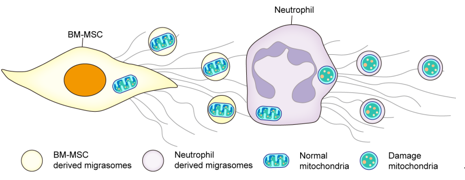
目前治疗脑淀粉样血管病的方法主要是对症治疗,疗效有限,且缺乏靶向疗法。间充质干细胞移植可改善阿尔茨海默病、急性缺血性脑卒中和帕金森病等疾病的认知和运动功能。此外,间充质干细胞疗法还能调节免疫系统,减少神经炎症,改善巨噬细胞系细胞对脑部病变的清除能力。脑淀粉样血管病和阿尔茨海默病有着相似的病理变化,都涉及淀粉样蛋白β沉积,而淀粉样蛋白β沉积有助于这两种疾病的发展,并通过血管完整性受损和神经炎症加剧认知障碍。因此,实验假设间充质干细胞疗法也可以通过调节免疫反应来改善脑淀粉样血管病的病理变化。实验显示骨髓间充质干细胞对脑淀粉样血管病小鼠模型(Tg-SwDI/B)具有保护作用。骨髓间充质干细胞治疗可改善Tg-SwDI/B小鼠的认知功能,减少神经炎症,并保持血脑屏障的完整性。从机制上讲,骨髓间充质干细胞治疗能增强中性粒细胞通过移行体(即线粒体胞吐)排出受损线粒体,从而保持中性粒细胞内线粒体的质量。中性粒细胞内的线粒体损伤会导致细胞损伤,包括产生活性氧和形成中性粒细胞胞外陷阱。中性粒细胞会激活线粒体更新的胞吐,从而进一步增强巨噬系细胞对其自身的清除。这些数据表明,骨髓间充质干细胞在中性粒细胞的迁移依赖性线粒体质量控制中发挥着重要作用,是一种治疗脑淀粉样血管病的有前途的候选干预策略。

https://orcid.org/0009-0006-3175-7833 (Sanxin Liu);

https://orcid.org/0000-0002-2118-0368 (Zhengqi Lu)
关键词: 骨髓间充质干细胞, 脑淀粉样血管病, 认知能力下降, 迁移体, 线粒体, 中性粒细胞线粒体胞吐

Abstract:

Current treatments for cerebral amyloid angiopathy are mainly symptomatic and have limited efficacy, and there is a lack of targeted therapies. Mesenchymal stem cell transplantation improves cognitive and motor function in conditions such as Alzheimer’s disease, acute ischemic stroke, and Parkinson’s disease. In addition, mesenchymal stem cell therapy modulates the immune system, reduces neuroinflammation, and improves resolution of brain lesions by cells of the macrophage lineage. Cerebral amyloid angiopathy and Alzheimer’s disease share similar pathologic changes involving amyloid-beta deposition, which contributes to the progression of both diseases and exacerbates cognitive deficits through impaired vascular integrity and neuroinflammation. Therefore, we hypothesized that mesenchymal stem cell therapy could also ameliorate the pathological changes seen in cerebral amyloid angiopathy by modulating the immune response. In this study, we show that bone marrow mesenchymal stem cells have a protective effect in a mouse model of cerebral amyloid angiopathy (Tg-SwDI/B). Bone marrow mesenchymal stem cell treatment improved cognitive function, reduced neuroinflammation, and maintained blood–brain barrier integrity in Tg-SwDI/B mice. Mechanistically, bone marrow mesenchymal stem cell treatment enhanced the expulsion of damaged mitochondria from neutrophils via migrasomes, in a process known as mitocytosis, thereby preserving mitochondrial quality within the neutrophils. Mitochondrial damage in neutrophils leads to cellular injury, including the generation of reactive oxygen species and the formation of neutrophil extracellular traps. Neutrophils activate mitocytosis to promote mitochondrial renewal, which further enhances their own clearance by macrophage lineage cells. Our findings demonstrate that bone marrow mesenchymal stem cells are a promising therapeutic candidate for cerebral amyloid angiopathy, as they play a significant role in migrasome-dependent mitochondrial quality control in neutrophils.

Key words: bone marrow mesenchymal stem cell, cerebral amyloid angiopathy, cognitive decline, migrasome, mitochondria, neutrophil mitocytosis