中国神经再生研究(英文版) ›› 2026, Vol. 21 ›› Issue (6): 2669-2680.doi: 10.4103/NRR.NRR-D-24-01540

• 原著:周围神经损伤修复保护与再生 • 上一篇    

骨骼肌神经元空间分布特征与肌肉表型的相关性


  • 出版日期:2026-06-15 发布日期:2026-04-18
  • 基金资助:

    该研究基金支持包括国家自然科学基金,82072162,项目负责人殷晓峰。

Inductive analysis of the spatial distribution characteristics of neurons that innervate skeletal muscle and their correlation with muscle phenotype

Xinyi Gu1, 2, #, Chen Huang1, 2, #, Shen Wang1, 2, Jin Deng1, 2, Shuhang Guo1, 2, Xiaofeng Yin1, 2, 3, *   

  1. 1Department of Trauma and Orthopedics, Peking University People’s Hospital, Beijing, China; 
    2Key Laboratory of Trauma and Neural Regeneration (Peking University), Ministry of Education, Beijing, China; 
    3National Center for Trauma Medicine, Beijing, China

  • Online:2026-06-15 Published:2026-04-18
  • Supported by:
    This work was supported by the National Natural Science Foundation of China, No. 82072162 (to XY).

摘要:

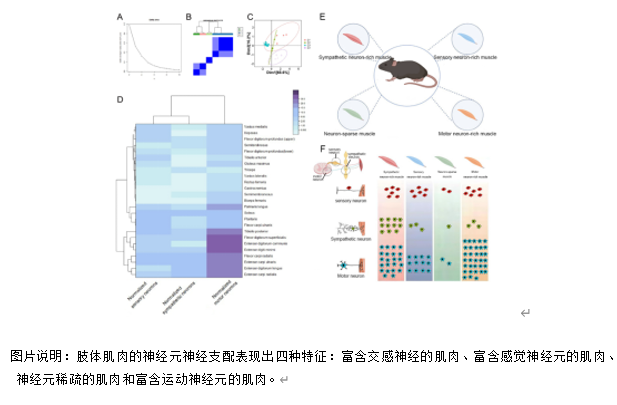
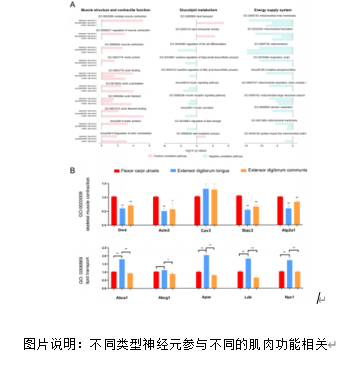
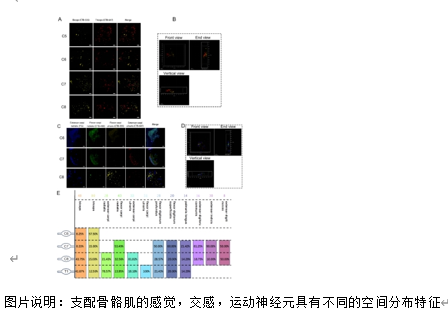
既往研究仅知道骨骼肌是由神经整体控制和协调的,在体内执行各种功能。然而,关于不同肌肉的神经控制特性是否不同,以及它们背后的意义,研究很少。此研究利用3DISCO兼容的多示踪剂技术来描绘支配肢体肌肉的感觉和交感神经元的空间分布模式。将小鼠肢体肌肉的转录组测序数据集整合到公共数据库中,并与神经元空间分布数据进行相关性分析,以揭示不同类型神经元对肌肉功能通路的独特影响。结果发现:(1)空间分布模式:与感觉和运动神经元相比,交感神经元的分布更集中。(2)肢体肌肉的神经元神经支配表现出四个特征:富含交感神经的肌肉、富含感觉神经元的肌肉、神经元稀疏的肌肉和富含运动神经元的肌肉。(3)感觉神经元密度主要与肌肉收缩结构和细胞pH值有关。交感神经元密度主要和蛋白激酶活性、肌肉脉管系统、肌肉钙依赖性蛋白激酶活性,脂质转运和囊泡释放有关。运动神经元密度主要与蛋白激酶活性、细胞粘附、氧化还原酶活性和胞吐有关。(4)与富含神经元神经支配的肌肉共定位的穴位也表现出相关的神经调节功能。这项研究有助于更深入地了解神经合作赋予肌肉不同的生理功能,为治疗各种神经肌肉疾病提供新的见解和实验证据。


https://orcid.org/0000-0001-9932-642X (Xiaofeng Yin)
关键词: 3D成像, 背根神经节, 运动神经元, 逆行追踪, 骨骼肌, 转录组, 交感神经节

Abstract: To perform various functions in the body, skeletal muscle is controlled and coordinated as a whole by nerves. However, there has been little research into whether the nerve control characteristics of different muscles are different, and the importance of these potential differences. In the present study, we used a three-dimensional imaging of solvent-cleared organ-compatible multi-tracer technique to explore the spatial distribution patterns of sensory and sympathetic neurons that innervate limb muscles. We integrated transcriptome sequencing datasets from mouse limb muscles in public databases and performed correlation analysis with neuronal spatial distribution data to reveal the unique effects of different types of neurons on muscle functional pathways. In terms of spatial distribution patterns, sympathetic neurons exhibited a more concentrated distribution than sensory and motor neurons. In addition, the neuronal innervation of limb muscles exhibited four different characteristics: sympathetic neuron-rich muscle, sensory neuron-rich muscle, neuron-sparse muscle, and motor neuron-rich muscle. Sensory neuron density was mainly associated with muscle contractile structure and cell pH, whereas sympathetic neuron density was associated with protein kinase activity, muscle vasculature, muscle calcium-dependent protein kinase activity, lipid transport, and vesicle release. Motor neuron density was mainly associated with protein kinase activity, cell adhesion, oxidoreductase activity, and exocytosis. These findings may contribute to a deeper understanding of how nerves cooperate to endow muscles with diverse physiological functions, thereby providing new insights and experimental evidence for the treatment of various neuromuscular diseases.

Key words: 3D imaging, dorsal root ganglia, motor neuron, retrograde tracing, skeletal muscle, sympathetic ganglion, transcriptome