中国神经再生研究(英文版) ›› 2026, Vol. 21 ›› Issue (10): 4954-4964.doi: 10.4103/NRR.NRR-D-25-01391

• 原著:脊髓损伤修复保护与再生 • 上一篇    下一篇

多组学预测脊髓损伤后调节瘢痕形成和神经修复的关键蛋白酶


  • 出版日期:2026-10-15 发布日期:2026-06-15

Multi-omics prediction of key proteases regulating scar formation and neural repair after spinal cord injury

Huan Jian1, 2, #, Jiahao Ren1, #, Jiawei Du1, #, Kailin Wu1, Shen Liu1, Yuanting Zhao2, *, Hengxing Zhou1, 3, 4, 5, *, Shiqing Feng1, 3, 4, 6, *   

  1. 1Department of Orthopedics, Tianjin Medical University General Hospital, International Science and Technology Cooperation Base of Spinal Cord Injury, Tianjin Key Laboratory of Spine and Spinal Cord, Tianjin, China; 
    2Department of Spine Surgery, Honghui Hospital, Xi’an Jiaotong University, Xi’an, Shaan Province, China; 
    3Department of Orthopedics, Qilu Hospital of Shandong University, Cheeloo College of Medicine, Shandong University, Jinan, Shandong Province, China; 
    4Shandong University Center for Orthopedics, Advanced Medical Research Institute, Cheeloo College of Medicine, Shandong University, Jinan, Shandong Province, China; 
    5Center for Reproductive Medicine, Shandong University, Jinan, Shandong Province, China; 
    6Department of Orthopedics, The Second Hospital of Shandong University, Cheeloo College of Medicine, Shandong University, Jinan, Shandong Province, China
  • Online:2026-10-15 Published:2026-06-15
  • Contact: Yuanting Zhao, PhD, doczhaoyuanting@126.com; Hengxing Zhou, PhD, zhouhengxing@sdu.edu.cn; Shiqing Feng, PhD, sqfeng@tmu.edu.cn.
  • Supported by:
    This study was supported by the National Natural Science Foundation of China, Nos. 82372413, 81972073 (both to HZ); Tianjin Municipal Science and Technology Commission’s Diverse Funds Research Program, No. 21JCYBJC00920 (to SL); and the National Key Research and Development Project of Stem Cell and Transformation Research, No. 2019YFA0112100 (to SF).

摘要:

神经损伤通常伴随着巨噬细胞的广泛浸润以及成纤维细胞和内皮细胞的激活。这些细胞的活性与多种蛋白酶水平上调有关,且这些蛋白酶有助于多种蛋白质的水解,进而破坏细胞外基质,并最终促进免疫细胞迁移到未受损神经组织中。此次实验整合了脊髓损伤的单细胞测序和Bulk RNA测序数据,以鉴定损伤后上调的蛋白酶相关差异表达基因。使用基因集变异分析(GSVA)、最小绝对收缩和选择算子(LASSO)回归和随机森林方法,确定了阿达玛赖氨酸、丝氨酸蛋白酶和基质金属蛋白酶是关键的蛋白酶类型。加权基因共表达网络分析结合机器学习算法预测了脊髓损伤中涉及的关键蛋白酶基因。免疫浸润和单细胞分析鉴定了富含蛋白酶的细胞类型及其空间定位。分子对接以及脊髓损伤小鼠模型验证了潜在的药物相互作用。得出Mmp12和Adam17是调节损伤进展的关键效应分子,并确定巨噬细胞、成纤维细胞和单核细胞是损伤后介导核心蛋白酶功能的主要细胞。随后的体内外实验表明,marimastat选择性抑制关键蛋白酶活性可减少脊髓损伤后的轴突脱髓鞘和纤维瘢痕形成,从而促进神经功能的恢复。综上,此次实验系统分析了与脊髓损伤后瘢痕形成和神经炎症相关的关键蛋白酶的类型和作用机制。


https://orcid.org/0000-0002-9822-0153 (Yuanting Zhao); 

https://orcid.org/0000-0003-0053-8970 (Hengxing Zhou); 

https://orcid.org/0000-0001-9437-7674 (Shiqing Feng)
关键词: 体RNA测序, 纤维瘢痕, 机器学习分析, 神经免疫学, 神经炎症, 神经功能, 蛋白酶, 单细胞RNA测序, 脊髓损伤, 治疗药物

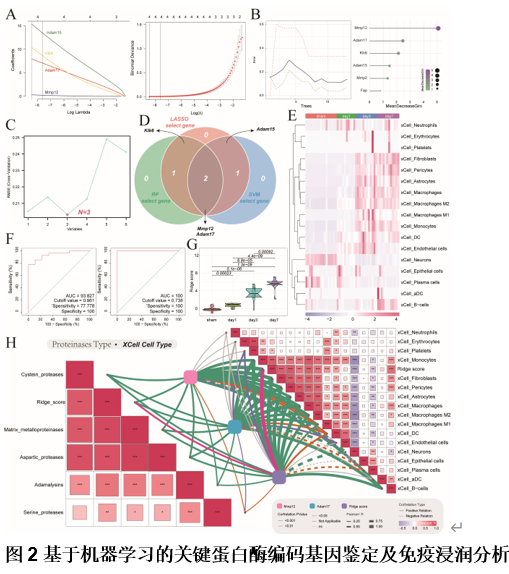
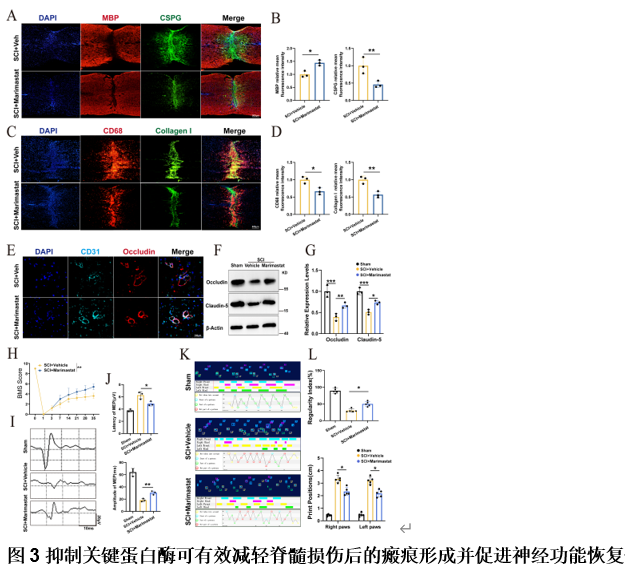
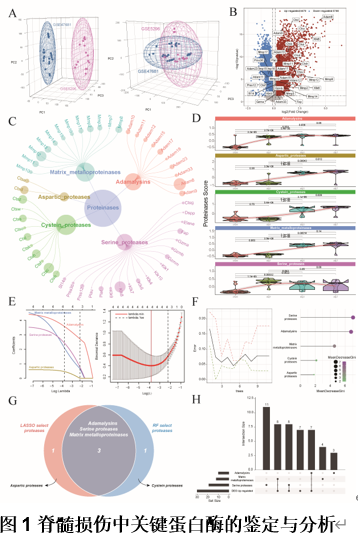
Abstract: Neurological injury is often accompanied by extensive infiltration of macrophages along with activation of fibroblasts and endothelial cells. The activity of these cells is associated with elevated levels of various proteases, which contribute to the hydrolysis of multiple proteins, disrupt the extracellular matrix, and further promote the migration of immune cells into uninjured neural tissue. In this study, we combined single-cell sequencing with bulk RNA sequencing data from spinal cord injury to identify up-regulated protease-related differentially expressed genes post-injury. Using gene set variation analysis, least absolute shrinkage and selection operator regression, and random forest methods, we identified adamalysins, serine proteases, and matrix metalloproteinases as key protease types. Weighted gene co-expression network analysis combined with machine learning algorithms helped predict critical protease genes involved in spinal cord injury. Immune infiltration and single-cell analyses were applied to identify cell types enriched in proteases and their spatial localization. Molecular docking and in vivo and in vitro assays using a mouse model of spinal cord injury were used to validate potential drug interactions. We identified Mmp12 and Adam17 as key effectors regulating injury progression, and determined that macrophages, fibroblasts, and monocytes are the primary cells mediating the functions of core proteinases after injury. Subsequent in vivo and in vitro experiments demonstrated that selective inhibition of key protease activity with marimastat reduced axonal demyelination and fibrous scar formation after spinal cord injury, thereby promoting the recovery of neurological function. Our study identified the key proteases that regulate spinal cord injury repair along with their mechanisms of action, and verified that inhibiting these proteases effectively alleviates scar formation and inflammatory cell infiltration, providing novel therapeutic targets for the treatment of spinal cord injury. 

Key words: bulk RNA sequencing, fibrous scar, machine learning analysis, neuroimmunology, neuroinflammation, neurological function, protease, single-cell RNA sequencing, spinal cord injury, therapeutic drug