中国神经再生研究(英文版) ›› 2026, Vol. 21 ›› Issue (7): 3103-3113.doi: 10.4103/NRR.NRR-D-24-01176

• 原著:脊髓损伤修复保护与再生 • 上一篇    下一篇

人脊髓背侧神经干/祖细胞移植制备人源化脊髓星形胶质细胞嵌合大鼠脊髓模型


  • 出版日期:2026-07-15 发布日期:2026-04-01
  • 基金资助:
    国家科技部重大项目(2022ZD0204704),国家自然科学基金青年项目(82301572)和中国博士后科学基金面上项目(2023M731202)

Generation of humanized spinal astrocytic chimeric rat spinal cord model by engrafting human dorsal spinal neural stem/progenitor cells

Wenjie Xu1, 2, #, Ziyu He1, 2, #, Jia Xu2, 3, 4, Ruoying Zhang1, 2, Shu Fan1, 2, Zhixian Liu1, 2, Wei Wang1, 2, 5, Hong Chen2, 3, 4, *, Xiaolong Zheng1, 2, 5, *   

  1. 1Department of Neurology, Tongji Hospital, Tongji Medical College, Huazhong University of Science and Technology, Wuhan, Hubei Province, China; 
    2Hubei Key Laboratory of Neural Injury and Functional Reconstruction, Huazhong University of Science and Technology, Wuhan, Hubei Province, China; 
    3Department of Rehabilitation, Tongji Hospital, Tongji Medical College, Huazhong University of Science and Technology, Wuhan, Hubei Province, China; 
    4Stem Cell Research Center, Tongji Hospital, Tongji Medical College, Huazhong University of Science and Technology, Wuhan, Hubei Province, China; 
    5Key Laboratory of Neurological Diseases of Chinese Ministry of Education, School of Basic Medicine, Tongji Medical College, Huazhong University of Science and Technology, Wuhan, Hubei Province, China
  • Online:2026-07-15 Published:2026-04-01
  • Contact: Hong Chen, MD, PhD, chenhong1129@hust.edu.cn; Xiaolong Zheng, PhD, xl_zheng@hust.edu.cn.
  • Supported by:
    This study was supported by the Ministry of Science and Technology of China (STI2030-Major Projects), No. 2022ZD0204700 (to WW); the National Natural Science Foundation of China, No. 82301572 (to XZ); and the China Postdoctoral Science Foundation, No. 2023M731202 (to XZ).

摘要:

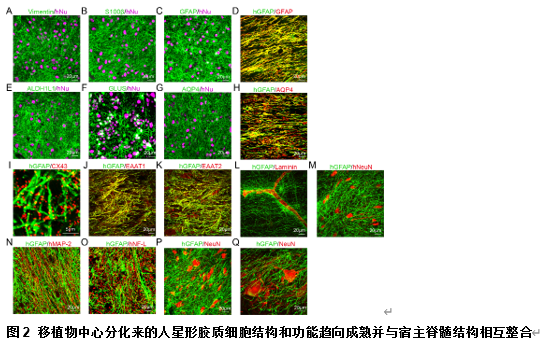
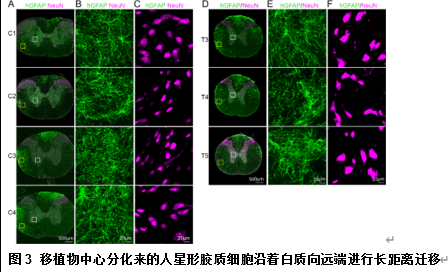
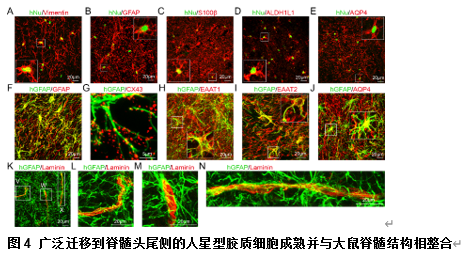
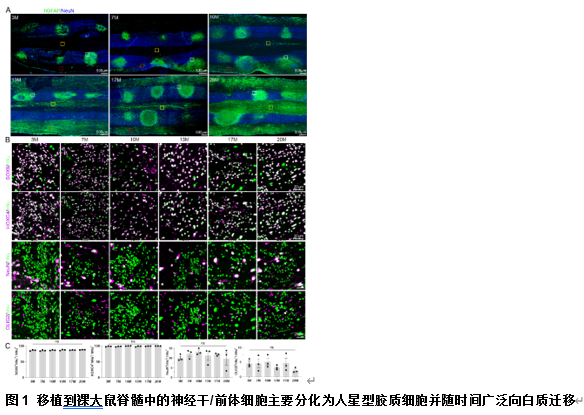
在人类脊髓中,星形胶质细胞是主要的神经胶质细胞。在体外研究人星型胶质细胞相对容易,但受限于体外环境的单纯性和体内环境的复杂性,限制了对人星型胶质细胞结构和功能的全面研究,并且人星形胶质细胞的在体研究也受限于伦理因素。因此,迫切需要开发有效的体内模型来研究人星形胶质细胞的结构与功能。此次实验首先于体外定向诱导人胚胎干细胞分化为人脊髓背侧神经干/前体细胞,并将这些细胞移植到裸大鼠颈段脊髓C5-T2节段的灰质中,构建了一种嵌合人脊髓星型胶质细胞模型。移植的人脊髓背侧神经干/前体细胞在裸大鼠脊髓环境中可存活至少20个月,并有超过90%的人来源脊髓背侧神经干/前体细胞向人星形胶质细胞分化。这些人星型胶质细胞可沿着白质进一步向脊髓的头尾侧进行长距离迁移,并表达星形胶质细胞骨架蛋白和功能相关蛋白。表明它们已经成熟并在结构上整合到大鼠脊髓中。因此,这种人源化脊髓星形胶质细胞嵌合大鼠脊髓模型可作为研究人脊髓星形胶质细胞在脊柱疾病中作用的有价值的工具。


https://orcid.org/0000-0002-4146-0499 (Xiaolong Zheng)
关键词: 嵌合, 脊髓, 人脊髓星形胶质细胞, 脊髓背侧神经干/祖细胞, 人胚胎干细胞, 长期, 迁移, 成熟

Abstract: In the human spinal cord, astrocytes are the major glial cells. In vitro studies of human astrocytes are relatively simple. However, the straightforward nature of the in vitro environment and complex nature of the in vivo environment limit comprehensive investigations into the structure and function of human astrocytes. Additionally, in vivo studies of human astrocytes are further limited by ethical issues. This means there is an urgent need to develop effective in vivo models to study the structure and function of human astrocytes. Here, we first directed human embryonic stem cells to differentiate into human spinal cord dorsal neural stem/progenitor cells in vitro, before transplanting these cells into the gray matter of the cervical spinal cord (C5–T2 segments) of naïve nude rats to create a chimeric human astrocytic rat spinal cord model. The transplanted human spinal cord dorsal neural stem/ progenitor cells survived for at least 20 months in the spinal cord environment of the rats, with over 90% differentiating into human astrocytes. These human astrocytes were able to migrate caudally for long distances along the white matter towards the spinal cord. They expressed astrocytic cytoskeletal proteins and functionally-related proteins, suggesting their maturation and structural integration into the rat spinal cord. Thus, this humanized astrocyte chimeric rat spinal cord model provides a valuable tool for studying the role of human spinal cord astrocytes in various spinal diseases. 

Key words: chimeric, dorsal spinal neural stem/progenitor cells, human embryonic stem cells, human spinal astrocytes, long-term, migration, spinal cord