中国神经再生研究(英文版) ›› 2026, Vol. 21 ›› Issue (8): 3824-3830.doi: 10.4103/NRR.NRR-D-25-00266

• 原著:退行性病与再生 • 上一篇    下一篇

血脂、降脂药物和肌萎缩侧索硬化:遗传相关性分析、全基因组关联多性状分析、组织特异性富集分析及双向多变量两样本孟德尔随机化分析


  • 出版日期:2026-08-18 发布日期:2026-04-28

Shared genetic link and causal inference between blood lipids, lipid-lowering drugs and amyotrophic lateral sclerosis

Kailin Xia1, 2, 3, #, Ninghao Huang4, #, Yajun Wang1, 2, 3, Gan Zhang1, 2, 3, Lu Tang1, 2, 3, Linjing Zhang1, 2, 3, Minhao Yao5, Zhonghua Liu5, Tao Huang4, *, Dongsheng Fan1, 2, 3, *   

  1. 1Department of Neurology, Peking University Third Hospital, Beijing, China; 
    2Beijing Key Laboratory of Biomarker and Translational Research in Neurodegenerative Diseases, Beijing, China; 
    3Key Laboratory for Neuroscience, National Health Commission/Ministry of Education, Peking University, Beijing, China; 
    4Department of Epidemiology and Biostatistics, School of Public Health, Peking University, Beijing, China; 
    5Department of Statistics and Actuarial Science, The University of Hong Kong, Hong Kong Special Administrative Region, China
  • Online:2026-08-18 Published:2026-04-28
  • Contact: Tao Huang, PhD, huangtao@bjmu.edu.cn; Dongsheng Fan, PhD, dsfan2010@aliyun.com.
  • Supported by:
    This study was funded by the National Natural Science Foundation of China, Nos. 82401670 (to KX), 81873784 (to DF), and 82071426 (to DF); the Clinical Cohort Construction Program of Peking University Third Hospital, No. BYSYDL2019002 (to DF); and the Postdoctoral Fellowship Program of China Postdoctoral Science Foundation, No. GZC20230152 (to KX).

摘要:

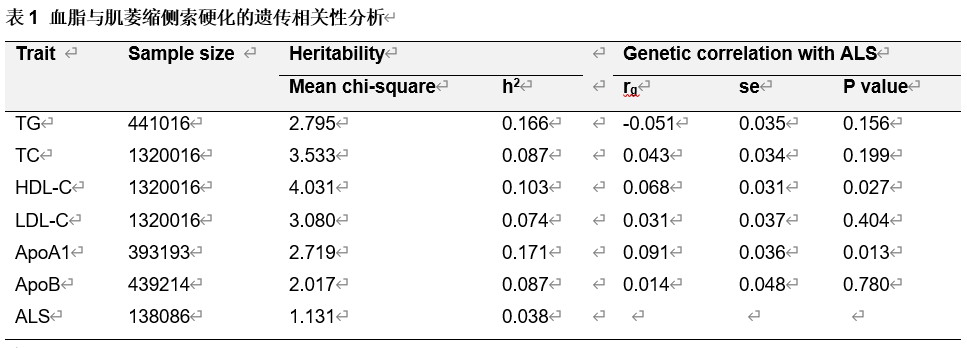
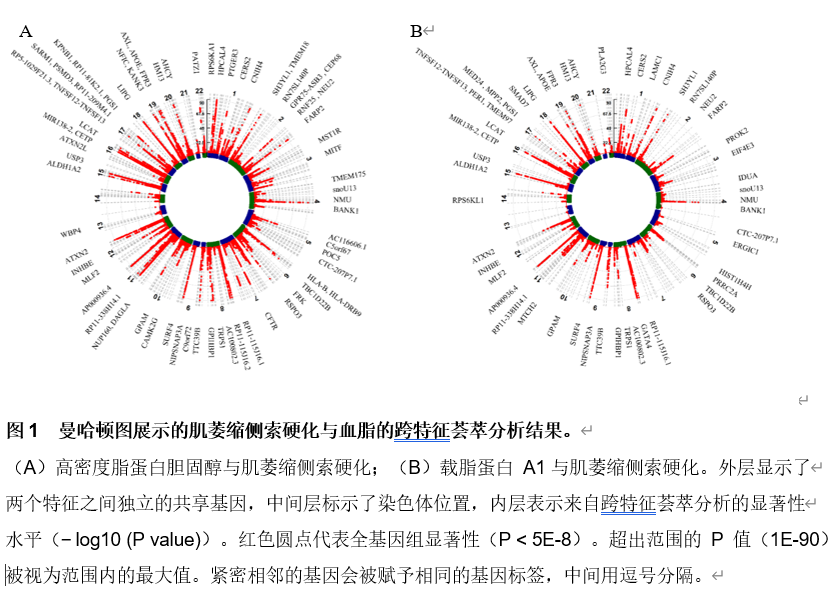
越来越多的证据表明,肌萎缩侧索硬化中存在脂质代谢异常,即使在症状出现之前也是如此,这暗示了它们之间的病因联系。然而,脂质代谢异常与肌萎缩侧索硬化症共病背后的遗传机制仍不清楚。因此,实验对于基于欧洲人群的全基因组关联研究汇总结果采用了遗传相关性分析,全基因组关联多性状分析、组织特异性富集分析及双向多变量两样本孟德尔随机化分析,以探索脂质和肌萎缩侧索硬化是否存在遗传相关性及因果关联,随后对降脂药物和肌萎缩侧索硬化进行了药物靶点孟德尔随机化分析。结果发现,肌萎缩侧索硬化与高密度脂蛋白胆固醇或载脂蛋白 A1之间存在正向的遗传关联,并确定了肌萎缩侧索硬化与高密度脂蛋白胆固醇之间共享71个独立的遗传位点以及肌萎缩侧索硬化与载脂蛋白 A1之间共有55个独立的遗传位点。这些共享的遗传位点富集在脂质代谢途径和酒精代谢途径。进一步降脂药物靶向孟德尔随机化分析显示,ACLY和PCSK9基因内单核苷酸多态性可通过降低高密度脂蛋白胆固醇降低肌萎缩侧索硬化风险,且ACLY和PCSK9抑制剂的组合肌萎缩侧索硬化的保护作用优于单独使用PCSK9抑制剂。综上,脂质与肌萎缩侧索硬化之间存在共同的遗传结构,孟德尔随机化分析支持基因预测的血脂升高与肌萎缩侧索硬化的风险相关,且使用ACLY或PCSK9抑制剂可能会改善疾病预后。


https://orcid.org/0000-0002-0328-1368 (Tao Huang); https://orcid.org/0000-0002-3129-9821 (Dongsheng Fan)
关键词: 肌萎缩侧索硬化, 遗传相关性, 遗传学, 工具变量, 降脂药, 脂质, 孟德尔随机化, 新陈代谢, 神经退行性疾病, 风险因素, 神经再生

Abstract: Growing evidence suggests that abnormal lipid metabolism occurs in amyotrophic lateral sclerosis, even in the presymptomatic stage, implying an etiologic link. However, the genetic mechanism underlying altered lipid levels in amyotrophic lateral sclerosis remains elusive. Therefore, in this study, we performed genetic correlation analysis, a cross-trait meta-analysis, tissue-specific enrichment analysis, and bidirectional two-sample Mendelian randomization analysis of European population to explore whether there is a genetic and causal relationship between lipids and amyotrophic lateral sclerosis. The effect of lipid-lowering drugs on amyotrophic lateral sclerosis was also evaluated using a drug target Mendelian randomization approach. The results showed a positive genetic correlation between amyotrophic lateral sclerosis and both high-density lipoprotein cholesterol and apolipoprotein A1 and identified 71 independent shared loci between amyotrophic lateral sclerosis and high-density lipoprotein cholesterol, as well as 55 independent shared loci between amyotrophic lateral sclerosis and apolipoprotein A1. These shared loci were enriched in the lipid metabolic pathway and the alcohol metabolic pathway. Further Mendelian randomization analysis targeting lipid-lowering drugs showed that single nucleotide polymorphisms within the ACLY and PCSK9 genes had a protective effect against amyotrophic lateral sclerosis risk by decreasing low-density lipoprotein cholesterol. The combination of ACLY and PCSK9 inhibitors has a greater protective effect on amyotrophic lateral sclerosis risk than that of PCSK9 inhibitors alone. In summary, there is a common genetic structure between lipids and amyotrophic lateral sclerosis. Mendelian randomization analysis supports an association between elevated blood lipids and the risk of developing amyotrophic lateral sclerosis, and the use of ACLY or PCSK9 inhibitors may improve disease prognosis. 

Key words: amyotrophic lateral sclerosis, genetic correlation, genetics, instrumental variables, lipid-lowering drug, lipids, Mendelian randomization, metabolism, nerve regeneration, neurodegenerative disease, risk factor