NRR:中国中山大学李道传团队联合山东中医药大学马柯团队以图寻智助力AI+精神疾病研究范式的转变
田旭,李道传,王宁,闫瑾,陈怡鸣,马柯
近年来,随着人工智能(AI)和深度学习(DL)技术的不断发展,医学领域的研究范式正在发生深刻变革。在生物医学和生命科学研究中,AI 已被广泛应用于疾病预测、药物筛选和图像诊断等多个方向。然而,精神疾病领域的AI应用仍面临独特挑战——精神障碍的临床表现复杂、个体差异大、缺乏明确生物标志物,传统诊断方法高度依赖主观经验,易造成误诊与延误。为解决这一难题,研究者们不断探索AI在精神疾病早筛、个体化诊断与治疗中的潜力,并尝试通过多模态数据融合提升分析准确性。然而,当前AI研究大多呈现“点状分析”的特点,缺乏对全局知识的系统整合与可视化表达。基于此,中国中山大学李道传团队联合山东中医药大学马柯团队构建了一个面向精神疾病领域的知识图谱,整合了人工智能技术、研究范式、疾病类型、数据格式和临床应用等多个维度,系统揭示AI在精神疾病领域中应用的发展趋势。这一研究不为精准精神病学的发展提供了重要的数据支撑与理论参考。
李道传联合马柯团队并上海交通大学的研究人员在《中国神经再生研究(英文)》(Neural Regeneration Research)上发表了题为“Interaction of artificial intelligence,
mental disorders, and diverse data modalities: Potential treatment management
based on the “method–disease–data” axis”的综述文章聚焦AI在精神疾病研究与诊疗中的应用现状与发展趋势,系统梳理了近年来AI,特别是ML与深度学习(DL)在抑郁症、精神分裂症、自闭症等常见精神障碍中的辅助诊断、早期筛查、个体化治疗等方向的研究工作,首次构建了涵盖“方法-疾病-数据-应用场景”四大维度的知识图谱(KG),并融合ClinicalTrials.gov中临床干预与流行病学数据。进一步分析发现,当前AI在精神疾病研究中的应用正逐步从理论建模走向临床实践,尤其在多模态数据整合、预测模型可解释性、跨文化语言模型适配等方向展现出新的突破与挑战。研究还对已有的AI干预临床试验进行了全面回顾,并提出针对落地转化瓶颈的策略框架。该工作为促进精神健康AI研究范式的系统化转型、推动交叉学科融合提供了重要的理论参考和实践依据。
AI技术在生物医学和临床研究中展现出巨大潜力,尤其在精神疾病这一复杂多变、表型异质性显著的领域,AI被寄予通过数据驱动方法改进诊断、预测和治疗效果的厚望。然而,现有关于AI在精神疾病中的综述大多聚焦于单一模型、单类数据或单种疾病,缺乏系统性的整合视角与方法论框架。该研究旨在:(1)构建跨越方法、疾病、数据与应用场景四大维度的KG;(2)系统整合近年来ML和DL在精神障碍研究中的关键应用;(3)分析AI干预精神疾病的临床试验进展与挑战,并提出策略建议。该研究采用如下方法步骤进行文献挖掘和综述(图1):
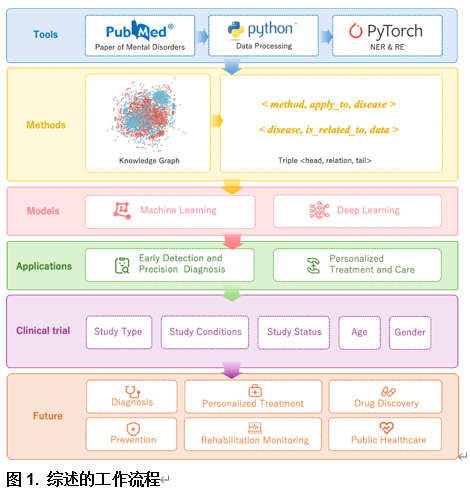
从PubMed检索并筛选1932篇AI相关精神疾病文献;使用NLTK进行句子切分,采用滑动窗口策略保留语境完整性;利用BioBERT进行命名实体识别(NER),并进行关系抽取(RE),构建两种三元组形式:<method, apply_to, disease> 与 <disease, is_related_to, data>;将抽取的3203个(三元组)导入Neo4j构建 KG;使用Cypher查询语句对图谱进行可视化分析。
通过图谱可视化分析,作者发现,以ML与DL为核心的方法类节点,连接了大部分疾病实体,表明其在该领域研究中的主导地位;ML方法更常与结构化数据相关联(如量表、EHR),典型适用于 PTSD、BD 等疾病;而DL则更常被用于情绪障碍、睡眠障碍等需处理非结构化数据的任务;某些疾病如SCZ、ASD、Depression等,机器学习与深度学习方法被交叉应用,反映出这类疾病的异质性与建模挑战。
在模型应用层面,总结了经典ML与DL方法在精神疾病领域的任务流程图(图2),明确了数据类型,数据表示、模型类型与评价指标间的关系。
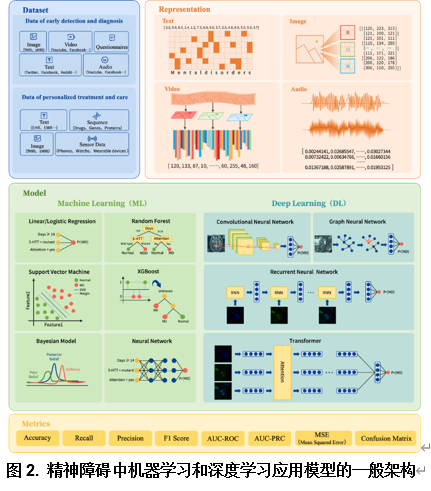
根据知识图谱,分别对ML与DL方法在精神疾病领域中的应用研究进行了探索,重点聚焦于诊断与治疗两个关键阶段的研究进展。在早期筛查与精准诊断方面,AI模型已被广泛应用于多种类型的数据源。非临床数据,特别是来源于社交媒体(如Facebook、Twitter、Reddit、Weibo等)的文本、图像、语音和视频,展现出独特的价值。这类数据能够反映个体的行为模式与情感特征,对于识别潜在的精神异常具有前瞻性意义。多项研究表明,利用自然语言处理(NLP)技术和深度神经网络,如双向长短期记忆网络(BiLSTM)、卷积神经网络(CNN)和Transformer架构,能够有效提取文本中的情感和心理特征,从而辅助预测如抑郁、焦虑、自杀风险等精神症状。相比之下,临床数据则具有更高的结构化程度与医学指向性,包括临床问卷、生理测量、脑影像(fMRI、sMRI)、脑电图(EEG)、遗传信息、代谢组学及多组学数据。AI在此类数据上的应用旨在克服传统诊断主观性强、效率低的问题,提升疾病识别与分型的准确性。值得注意的是,在多模态预测方面,联合使用如影像+临床、EEG+行为等数据的研究逐年增长,表明模型泛化能力与可解释性需求逐渐增强 。
在个体化治疗与动态干预层面,AI主要通过对多源数据的融合分析来预测药物疗效、制定治疗策略、辅助临床决策。一些模型专注于预测抗抑郁药或抗精神病药的疗效,如利用Hamilton评分与EEG数据构建的梯度提升模型,以及结合SNP与转录组信息训练的XGBoost模型。研究显示,模型在预测药物响应方面的AUC可达0.84以上,部分模型如SVM对clozapine疗效的预测准确率甚至超过90%。此外,越来越多的工作将AI嵌入到可穿戴设备与移动端应用中,实时采集个体的行为、生理与环境数据,通过深度模型进行状态监测与风险评估,为治疗提供持续反馈。
为进一步评估人工智能在精神疾病中的临床转化程度,该研究还系统性挖掘并分析了 ClinicalTrials.gov 平台上500余项以AI为核心的精神健康干预研究,结合疾病类型、研究阶段、数据形式与样本规模等维度进行交叉分析(
图3)。结果显示,抑郁症、焦虑障碍及自闭症谱系障碍为AI应用最集中的疾病领域,研究多处于0期或I期验证阶段,广泛采用开放标签与非随机设计,说明AI技术虽具显著潜力,但在临床路径中尚处早期试水阶段,缺乏系统化规范与高质量循证基础。反映出当前AI在精神疾病领域的“从实验室走向临床”过程中所处的实际发展阶段与瓶颈。然而,目前大多数研究样本量有限,部分仍停留在可行性测试阶段,严重限制了模型的泛化能力与应用推广。因此,推动AI临床转化需依托多中心大样本平台与伦理规范体系协同发展。
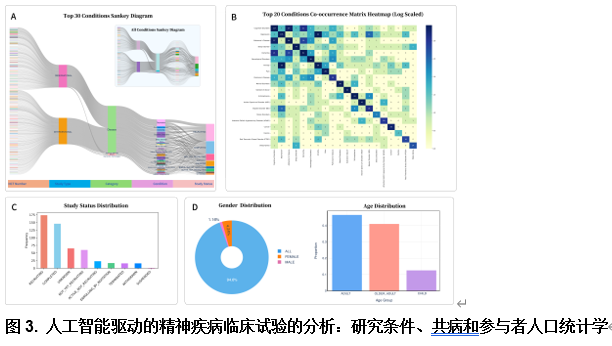
在深入梳理精神疾病领域AI研究脉络的基础上,作者进一步将其置于更广阔的技术发展语境中,系统对比了人工智能本身的发展历程、AI在医学领域的整体演进轨迹,以及其在精神疾病中的应用推进节奏。如图4所示,从时间尺度上看,AI在医学的应用高峰出现在2015年后,医学图像与诊疗辅助系统的突破最为明显;而AI在精神疾病中的广泛应用,则主要集中在2019年以后,相关研究呈现爆发式增长,覆盖从早期筛查、风险预测,到药物反应建模与个体化干预的全流程。尽管整体起步稍晚,但精神疾病AI研究近年来在数据深度、模型精度与临床对接能力方面取得显著进展,逐步补齐早期差距。这一对比揭示出精神健康AI研究的独特性与复杂性,也反映出其与AI通用技术演化及医学AI主流路径之间的错位与融合趋势。未来,随着跨学科交叉的加深和数据伦理治理的完善,精神疾病AI有望借助医学AI的标准化经验,实现从“辅助工具”向“智能决策支持系统”的跃升。
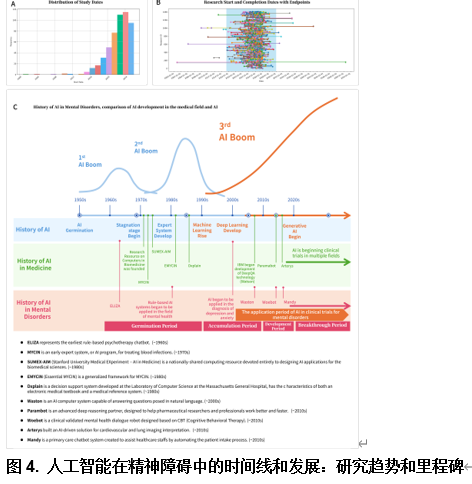
尽管人工智能在精神疾病研究与诊疗中的应用已取得初步成效,但在推动AI临床转化和广泛部署过程中仍面临诸多挑战。首先,数据异质性与隐私性问题依然突出。精神障碍相关数据涵盖语言、音视频、生理传感、影像、多组学等模态,不仅来源多元、结构复杂,而且受伦理审查和数据共享机制限制,导致高质量、跨人群的大样本数据构建仍面临困难。其次,AI模型的泛化能力与可解释性不足成为限制其临床可用性的关键瓶颈。尤其在精神疾病这一高度异质、临床诊断高度依赖主观判断的领域,黑箱模型往往难以为临床医师和患者所信服,亟需开发高透明度、具因果推断能力的模型框架。此外,AI系统的验证机制尚不成熟。目前多数研究仍停留在小样本验证或可行性测试阶段,进入多中心、随机对照试验的项目仍属少数,缺乏统一的评估标准、质量控制与监管准则。这限制了AI模型从“科研级”向“医疗级”的真正过渡。同时,不同地区文化语言背景下模型的迁移能力也是现实挑战,尤其对于以自然语言处理为核心的情感识别、意图预测模型而言,跨文化适配能力直接决定其全球化推广潜力。
尽管挑战众多,AI在精神疾病领域的未来发展仍被普遍看好。首先,随着多模态数据融合技术不断成熟,未来可实现从症状行为到生物标志物的全景式智能建模。其次,大语言模型(LLMs)与心理健康融合正成为研究热点,如MentalBERT、MentalRoBERTa、MentaLLaMA等语言模型已初步展现出对精神状态表征和对话支持的潜能,推动AI从“识别”走向“陪伴”与“干预”。再次,随着政策推动和伦理规范的日益完善,未来AI有望在患者随访、疗效评估、治疗路径优化中发挥更积极作用。
总之,当前AI在精神疾病研究中的应用仍处于“早期规模化试验”阶段,但正在逐步向“标准化临床部署”过渡。借助跨学科协作、知识图谱等系统整合工具,本研究为精神健康AI的发展提供了结构化蓝图与现实路径参考,也为推动人工智能在复杂人类心理疾病中的可信、可用与可控应用奠定了坚实基础。
综上所述,该研究系统性梳理了人工智能技术,尤其是机器学习与深度学习方法,在精神疾病诊疗中的研究进展与临床转化路径。作者构建了一个以“方法—疾病—数据—应用场景”为主线的结构化知识图谱,并整合ClinicalTrials.gov平台上临床试验数据。全面揭示了AI在抑郁症、精神分裂症、自闭症等精神障碍中的应用趋势。研究发现,目前AI在精神健康领域的应用正逐步从理论建模走向实践探索,尤其在多模态数据融合、可解释模型设计及跨文化模型适配等方面已展现出突破潜力。同时,作者对精神疾病领域AI的发展时间轴进行梳理,并与医学AI及通用AI发展进行横向对比,指出精神疾病相关AI的发展起步虽晚,但因精神障碍的复杂性,反而更凸显出AI建模在该领域的价值。
当然,该研究仍存在一定局限。首先,文献数据来源主要依赖PubMed,可能忽略其他数据库研究,存在发表与语言偏倚。其次,知识图谱的构建高度依赖BioBERT进行命名实体识别,尽管其性能已较为优越,仍难完全避免信息提取误差。此外,临床数据分析所引用的注册信息截至2021年,未涵盖近3年新进展,且未能评估AI在精神科诊疗中实现独立辅助决策的可能性。未来研究应引入更多样本量更大、代表性更强的多中心数据,提升知识图谱的动态更新能力,并探索AI在临床路径中的自主决策潜力,从而推动AI由“研究工具”真正向“临床助手”过渡。该研究为后续AI精神健康应用的制度化评估、实践验证与策略优化提供了理论基础与现实参照。
原文链接:https://doi.org/10.4103/NRR.NRR-D-25-00121
