中国神经再生研究(英文版) ›› 2026, Vol. 21 ›› Issue (7): 3055-3062.doi: 10.4103/NRR.NRR-D-24-01150

• 原著:脑损伤修复保护与再生 • 上一篇    下一篇

端粒长度:蛛网膜下腔出血后长期发生认知功能障碍的预测标志物


  • 出版日期:2026-07-15 发布日期:2026-03-31

Telomere length as a predictive marker for long-term cognitive function in a mouse model of subarachnoid hemorrhage 

Qia Zhang1, 2, #, Chaoran Xu1, 3, #, Jiayong Fan1, Chengjian Lou1, Jiarui Chen2, Jianmin Zhang1, 2, *, Jun Mo1, *   

  1. 1Department of Neurosurgery, The Fourth Affiliated Hospital of School of Medicine, and International School of Medicine, International Institutes of Medicine, Zhejiang University, Yiwu, Zhejiang Province, China; 
    2Department of Neurosurgery, The Second Affiliated Hospital, Zhejiang University School of Medicine, Hangzhou, Zhejiang Province, China;
    3Department of Neurosurgery, First Affiliated Hospital of Wenzhou Medical University, Wenzhou, Zhejiang Province, China
  • Online:2026-07-15 Published:2026-03-31
  • Contact: Zhang, MD, zjm135@zju.edu.cn; Jun Mo, MD, mojun@zju.edu.cn.
  • Supported by:
    This study was supported by the National Natural Science Foundation of China, No. 81901336 (to JM).

摘要:

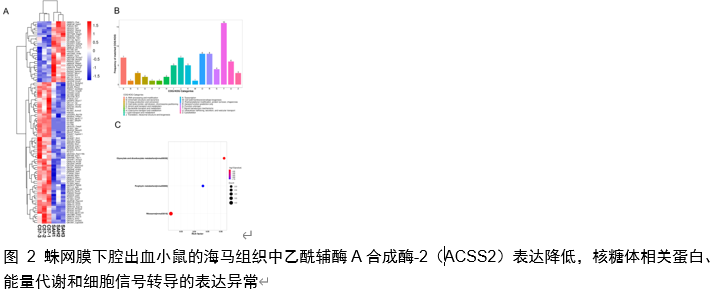
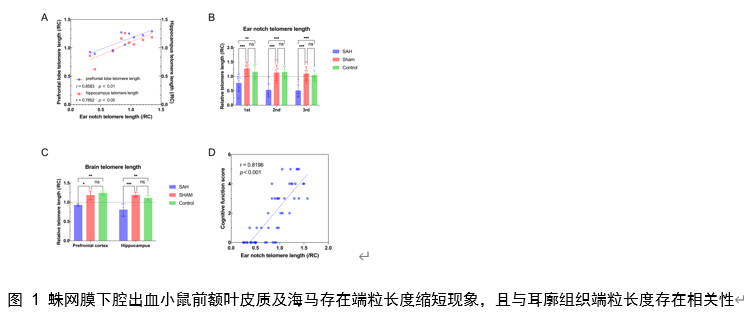
认知障碍是蛛网膜下腔出血后长期神经功能障碍的主要表现之一。目前缺乏预测长期预后的生物标志物。为验证端粒长度可作为蛛网膜下腔出血期预后的预测标志物。实验小鼠对蛛网膜下腔出血小鼠模型进行的神经行为评估获得综合神经学测试分数。同时,使用qPCR分析从耳耳廓组织和脑组织提取的DNA的相对端粒长度。此外,采用蛋白质组学分析研究海马组织中蛋白质表达的差异。蛛网膜下腔出血小鼠表现出长期的神经认知障碍。端粒长度与神经测试分数之间存在显著的正相关。蛛网膜下腔出血小鼠的海马组织中乙酰辅酶A合成酶-2表达降低,核糖体相关蛋白、能量代谢和细胞信号转导的表达异常。蛛网膜下腔出血小鼠脑组织中的端粒长度缩短,海马代谢紊乱。端粒长度可作为实验性SAH后小鼠长期认知功能的预测标志物。

https://orcid.org/0000-0002-3184-1502 (Jianmin Zhang); 
https://orcid.org/0000-0002-0389-7453 (Jun Mo)

关键词: 端粒长度, 蛛网膜下腔出血, 长期预后, 乙酰辅酶A合成酶-2, DNA 损伤反应, 脑衰老

Abstract:

Subarachnoid hemorrhage is a subtype of stroke that causes severe neurological damage and is associated with poor long-term prognosis. Cognitive impairment is a major manifestation of long-term neurological dysfunction in patients with subarachnoid hemorrhage. However, there is notable absence of biological markers to predict long-term prognosis in this patient population. Given the aging-like neurocognitive phenomena associated with subarachnoid hemorrhage, this study postulates that telomere length, a recognized biomarker for aging, could be used as a prognostic indicator for subarachnoid hemorrhage. A left internal carotid artery intravascular puncture mouse model was used to simulate subarachnoid hemorrhage. Comprehensive neurological test scores were obtained through neurobehavioral assessments conducted at one-month intervals. Concurrently, the relative telomere length was analyzed by quantitative polymerase chain reaction, which was performed using DNA extracted from ear notch and brain tissue after each assessment. Furthermore, proteomic analysis was employed to investigate differential protein expression in hippocampal tissue. Subarachnoid hemorrhage mice exhibited persistent neurocognitive impairment over a prolonged period of time. There was a significant positive correlation between telomere length and neurological test scores, confirming the usefulness of telomere length as a prognostic indicator in subarachnoid hemorrhage. Hippocampal tissue from subarachnoid hemorrhage mice showed reduced expression of acetyl-coenzyme A synthetase-2 and abnormalities in the expression of proteins related to ribosomes, energy metabolism, and cellular signal transduction. This study confirmed telomere shortening in the brain and metabolic disturbances in the hippocampi of subarachnoid hemorrhage mice. Thus, telomere length is a predictive marker for long-term impairment of cognitive function in mice following experimental subarachnoid hemorrhage.

Key words: acetyl-coenzyme A synthetase-2, brain aging, DNA damage response, long-term prognosis, subarachnoid hemorrhage, telomere length